
TONY LACEY:
I can’t really remember now quite why Jan Mark and I became close. In the 1970s I was at Kestrel, Penguin’s children’s hardcover list, largely working on non-fiction. Kestrel, in effect the old Longman Young Books imprint, had a very good fiction list, which included luminaries like Leon Garfield, Barbara Willard and Philippa Pearce, and to these distinguished names were added Jan and Michelle Magorian while I was there.
I liked Jan’s book Thunder and Lightnings – who could not? – and I liked her too. She was deceptively quiet, possibly even a little shy, but there was no escaping her sharp intelligence and fierce wit. (‘Escaping’ is perhaps the right word – people were a little afraid of her.) And her integrity and dedication to writing too. She was such a naturally gifted writer that it would have been easy for her to duplicate the success of Thunder and Lightnings, but she chose instead to write a couple of disturbing fantasy novels that must have reflected something in her personality – a dark, pessimistic streak which ran against the sunniness of her first book. Her ambition and weightiness appealed to me, and I suppose our closeness was down to my help and engagement with these books. I don’t want to exaggerate this, but I can now see that they were written at a time I was thinking of transferring to adult publishing, and even then it struck me that these were books that a person of any age could enjoy. They were meaty.
I wish we’d kept up the relationship but sadly we lost touch eventually. Except there’s one funny coda to our friendship. Right at the end of the 70s I moved for a year to set up a children’s list at Granada Publishing and it was suggested we did a children’s novel tied to a popular BBC TV soap. I desperately needed a 50,000 word novel written around a few existing characters, all living in a melodramatic modern world. About as far removed from The Ennead as you could imagine! Why I thought of Jan I can’t remember, nor why she agreed to do it. We met at Shepherd’s Bush tube station and had a coffee before going to meet the producer at Broadcasting House. I do have a vivid memory of thinking, what on earth have I let Jan in for. Her quizzical, amused manner throughout the meeting suggested that she thought of it as an adventure, and she approached the writing of the book like a trooper: it was delivered perfectly on time, it was more than fine, and it was a sales success. I still think of it as our little secret.

MAURICE LYON:
I first met Jan in 1986. It was my first job as a children’s fiction editor and I was very new to the recently formed Penguin Children’s Books, combining for the first time the Viking Kestrel hardback and Puffin paperback lists under Liz Attenborough. Jan had been most recently edited by Viking Kestrel’s editorial director Sally Floyer, and she had a huge critical reputation as one of only three multiple winners of the Carnegie Medal. And I think it is true to say she was considered somewhat daunting by the wider team, so I was apprehensive to say the least, so much so that I remember wearing a suit on one of the few occasions in my publishing career.
And over lunch it did seem that Jan was interviewing me about my reading habits and tastes to assess whether my editorial judgement was one she could respect. Thankfully for me, nearly all the books she mentioned I had read and had an opinion of. I seem to remember that the ice was properly broken when we discovered we had an abiding love of Flann O’Brien’s The Third Policeman.

From then on, I enjoyed a thoroughly enjoyable relationship with Jan. She was in the process of writing Dream House, the second book of a three-book contract that her agent Murray Pollinger had secured for her with Penguin following the Carnegie Medal award for Handles three years previously. Man in Motion was the third book of that contract. I do remember making a couple of minor suggestions to do with pace early in the novel which she acknowledged by making the smallest of changes, but she didn’t really agree with me.

Jan never needed much editing as such, as her writing process was rigorous and highly evolved – I don’t remember how she evolved this process or if she learnt it from anyone else. It involved typing three complete drafts of each novel from scratch. The first was a sort of exploration of her characters and the events that shaped them so she could discover where her story was going. The second draft was a major rewrite that consolidated all that she learnt about her story from the first. And the final draft was a polished version of the second.
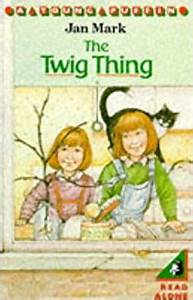
Alongside her novels, she wrote exquisite short fiction – The Twig Thing was one such that I commissioned her to write for a new series for beginner readers, and it arrived fully formed with not a word out of place but resonant with feeling and insight. I think what she needed from an editor was not so much a guiding hand when it came to writing, but more someone whom she could rely on to understand her work and give her room to explore where her art would take her.
She had strong opinions about illustrators and was scathing about those who relied on photographs from which to paint – there seemed to be a particular vogue for such work for covers of children’s fiction in the 80s. Her art school education was a big influence and she especially prized artists who could draw from their imaginations and always sought to influence the choice of illustrator for her books. Paul Cox was one such illustrator that she greatly admired who was always in great demand. Eventually, he illustrated the cover of her teen collection, A Can of Worms.
As a coda, you might be interested to read Jan’s article in Books for Keeps about being edited – ‘The Craft of Writing’, from BFK No. 132.
 Jan Mark Is Here